

How Often Do I Have To Clean A Wholehouse Tankless Electric Water Heater
Think about it: The fashion near households in this country rut water is absurdly wasteful. We fill up up large 40- to 50-gallon storage tanks, then cascade energy into them 24/vii, yr in and twelvemonth out, to brand sure nosotros have hot h2o at the fix whenever we desire information technology.
But oftentimes it doesn't work out that way. If a teenager takes a long shower, or a spouse settles in for a tub soak, there tin be a long await for that emptied tank to reheat. So in that location are the nagging worries: Is it filled with energy-robbing sediment? Will it leap a leak? Both are reasonable concerns, as tanks generally fail in eight to 12 years.
Tankless H2o Heater Installation: Is It Worth It?
These are the arguments for investing in a tankless water heater. It generates hot water but when you need it—and for as long equally you need it—saving 27 to 50 percentage of fuel costs over tank-type heaters. (A typical gas-fired tank wastes 40 to l percent of the fuel it burns.)
And because in that location's no tank to fail, there'southward about no chance of a catastrophic leak. What's more than, since their introduction in the Us in the 1990s, tankless heaters have become increasingly sophisticated, with features like built-in recirculating pumps (for "instant" hot water), and wireless connectivity that tells you via smartphone exactly when a unit of measurement needs maintenance.
Beneath is our guide to tankless water heaters. In it, we'll explain how a tankless water heater works, tell y'all what y'all need to know before you purchase one—and before the installer arrives—and let y'all in on the units' operating quirks, and then at that place won't be any surprises if you go tankless.
How Does a Tankless H2o Heater Work?

- It all starts when you turn on the hot-h2o tap (one).
- A flow sensor (2) detects water coming into the heater and sends a signal to the command console to first producing hot water.
- In a gas-fired unit of measurement, the control panel (iii) turns on the fan (iv), which draws in outside air, opens the gas valve (5) that lets in the gas, and ignites the burner (6).
- The heat exchanger (7) captures rut from the flames and transfers it to the water moving through the exchanger's tubing.
- The mixing valve (8) tempers the superheated water exiting the exchanger.
- If the temperature sensor (ix) detects that the water exceeds or falls curt of the desired setting, the console will accommodate the gas valve, the mixing valve, and the flow-regulating water valve (10) accordingly.
- A sealed vent (11) (or pair of vents) through a roof or outside wall carries away frazzle gases and conveys combustion air to the burner.
Thanks to: Phillip Maxwell, Residential Product Manager, Rheem; Eric Manzano, Product Training Supervisor, Noritz; Joe Holliday Senior Director, Production and Business organization Development, Rinnai; Fred Molina, Water Heater Products Director, Bosch Thermotechnology
What to Know About Tankless Water Heaters
:format(webp):no_upscale()/cdn.vox-cdn.com/uploads/chorus_asset/file/19523502/basics.jpg)
How Much Does a Tankless Water Heater Cost?
Prices range from about $170 for small gas-fired units to more than $2,000 for high-output heaters that can supply 2 showers at the aforementioned time; $ane,000 is most boilerplate.
Tankless electrical heaters run between $ninety and $900. First-time installation costs run more than a elementary tank replacement. (Encounter subsection below, entitled "Electrical Tankless H2o Heater Installation.")
How to Install a Tankless Water Heater
This is definitely a job for a pro, as information technology involves making leak-free water, vent, and gas connections, in the case of gas or propane units, or upgrading the wiring and circuit-billow panel, in the instance of electrical units.
Tankless Water Heater Maintenance
Sign up to have a pro provide annual service, including cleaning or irresolute h2o and air filters and checking the burner. In areas with hard water, a vinegar flush every 500 hours keeps mineral buildup—scale—from bottleneck the oestrus exchanger. That 20-infinitesimal task can be washed by either a pro or a homeowner.
How Long Exercise Tankless Water Heaters Last?
Gas-burning tankless water heaters should operate for xx years or more, two or iii times longer than tank-type heaters. Tankless electrical units have shorter life spans, on the order of seven to ten years.
Where Can I Purchase One?
Plumbing supply stores, large-box stores, and online retailers all carry these heaters. Or order one through your plumber.
Pros and Cons of Tankless Water Heaters
:format(webp):no_upscale()/cdn.vox-cdn.com/uploads/chorus_asset/file/19523585/pros_cons.jpg)
PRO: They're Compact
Newer tank-type water heaters have grown bigger every bit federal regulations now crave thicker insulation to reduce standby heat loss.
So they may not be able to fit into spaces where an quondam heater of the same capacity could go. Tankless gas heaters are about the size of a suitcase and hang on the wall.
PRO: They're Safer
Unlike a tank-type heater, they won't spill gallons of water if they jump a leak, or harbor Legionella bacteria, or tip over in an earthquake. And because the air supply and frazzle vents are sealed, carbon monoxide can't leak into the house due to backdrafting.
PRO: They're Easy to Winterize
Owners of holiday homes know well how long it takes to drain a h2o-heater tank before closing up a house for the winter. With a compressor, you can drain a tankless heater in a few seconds; and so you but unplug it.
CON: They're Sensitive to Irksome Flow
If there's too much scale buildup in the pipes, or faucet and showerhead aerators are clogged, or a turned-down faucet reduces water menses to near 0.three gpm, these units automatically close off.
CON: The Payback Takes Awhile
Compared with a tank-type heater costing $400 or and then, a $ane,000 tankless gas heater may salvage a household just about $100 per year, depending on how efficient it is and how much hot water is used.
Simply considering these tankless gas units last longer, the savings kicks in subsequently six years, almost when many tanks are nearing their demise.
New Tankless H2o Heater Technology
:format(webp):no_upscale()/cdn.vox-cdn.com/uploads/chorus_asset/file/19523704/whats_new.jpg)
Tankless engineering science is constantly improving. Here are some of the latest refinements:
Higher Efficiency
Condensing gas heaters can extract up to 96 percent of a fuel'due south heat—a 17 per centum improvement over first-generation tankless units—thanks to a second heat exchanger that captures much of the frazzle heat before it goes out the vent.
They're virtually 25 percent more expensive than noncondensing heaters, and they create an acidic condensate that has to be neutralized. If a heater isn't equipped with a built-in neutralizing cartridge, the installer has to add together i.
Instant Hot Water
Tankless units take almost 15 seconds to bring water upwardly to temperature, only you still take to wait for that hot water to go far at your shower head or faucet, simply equally y'all do with a tank-type heater.
When the altitude between heater and fixture exceeds 50 feet, look for units with a congenital-in recirculation pump, which saves h2o and reduces waiting time. The pump, which can exist turned on by a timer, a push button push button, a move sensor, a smart speaker, or a smartphone (above), pushes the cold water in the pipes back through the heater.
Later on about a minute, the pump shuts off and you get hot h2o seconds after opening the tap.
Wi-Fi Compatible
Tankless units with digital connectivity let y'all adjust the temperature and monitor gas and hot-h2o usage on your phone.
More important, the unit tin identify the source of a problem. Relay that information to your plumber and he or she can prove up knowing exactly what needs to be done. That feature as well eliminates whatever guesswork most when it's time to descale.
Tankless Water Heater Rebates: A Bully Manner to Save
:format(webp):no_upscale()/cdn.vox-cdn.com/uploads/chorus_asset/file/19523747/pro_advice.jpg)
What Size Tankless Water Heater Practise I Need?

Hither's how the pros make certain your heater delivers enough hot h2o.
It takes a big outburst of BTUs for a tankless heater to plow cold h2o into hot water in just a few seconds. Simply if a heater'due south Btu output can't keep upwards with need, it volition cut back the flow, or, worse case, deliver lukewarm water.
To make up one's mind whether a heater will be able to meet a household's needs, a plumber looks at 3 factors:
- The temperature of the water coming into the heater
- The height demand for hot water in gallons per minute (gpm)
- The heater'south efficiency, as indicated past its Uniform Energy Cistron, establish in the product specs.
- The showtime pace: A pro finds out how many Btus per gallon a heater needs to raise the incoming water to 120 degrees (see the map in the side by side slide).
- Next comes acme demand, the sum of the period rates for every appliance and fixture that could be using hot h2o at the same time. (Those rates are listed in the next slide.) The total gets shaved by 20 per centum, since we don't breast-stroke or launder in 120-degree water. Yous can reduce elevation demand by upgrading to low-flow fixtures and water-saving appliances, or by property off on the washing when the shower is in employ.
- Total Btu output is calculated by plugging the Btus-per-gallon and peak-demand figures into the formula. If that output falls between two models, get the one with the college Btu rating. And if the output exceeds 198,000 Btus, the maximum for residential gas heaters, you'll need two smaller units that work in tandem.
Btus Output Guess
Don't want to do the math? Utilise these figures to estimate how much heater output y'all'll demand.
- 1 bath, 1–2 people: 140,000 Btus
- 2 bathrooms, 2–iii people: 190,000 Btus
- 3 bathrooms, 3–v people: 380,000 Btus
Btus Per Gallon past Region

Fixture flow rates
- Showerhead: 1.25–2.5 gpm
- Kitchen or bath faucet: 1.five–two.2 gpm
- Tub filler faucet: 4 gpm
- Dishwasher: i–two.v gpm
- Washing car: 1.5–iii gpm
How to Determine gpm?
To find the actual gpm of a fixture, fourth dimension how many seconds information technology takes to fill a bucket to a 1-quart mark. Dividing 15 by that number of seconds equals gpm.
Electric Tankless Water Heater Facts
:format(webp):no_upscale()/cdn.vox-cdn.com/uploads/chorus_asset/file/19523816/electric_option.jpg)
Homes without a gas line or propane tank tin can besides enjoy the advantages of on-need hot water by installing tankless units powered by electricity. These units, which heat water with thick copper rods, are quieter and about a third smaller than gas or propane tankless heaters. And because they don't need vents, they can be installed almost anywhere, including nether sinks and in pocket-sized closets.
One drawback to electrical units is its limited output, which tops out at 36 kilowatts, or about 123,000 Btus. That may exist enough to supply a whole firm in areas with warm groundwater, just in colder climes they're better suited to point-of-utilize service, where the demand for hot h2o doesn't go also loftier. Whichever type you choose, it will need sufficient amperage at the main console and heavy-approximate wires.
Too, electric heaters last but nearly one-half as long as gas units: Typical warranties are iii to 5 years. In one case the heating elements fry, it usually costs about as much to supervene upon the entire heater equally it does to swap in new elements.
Tankless Water Heater Installation
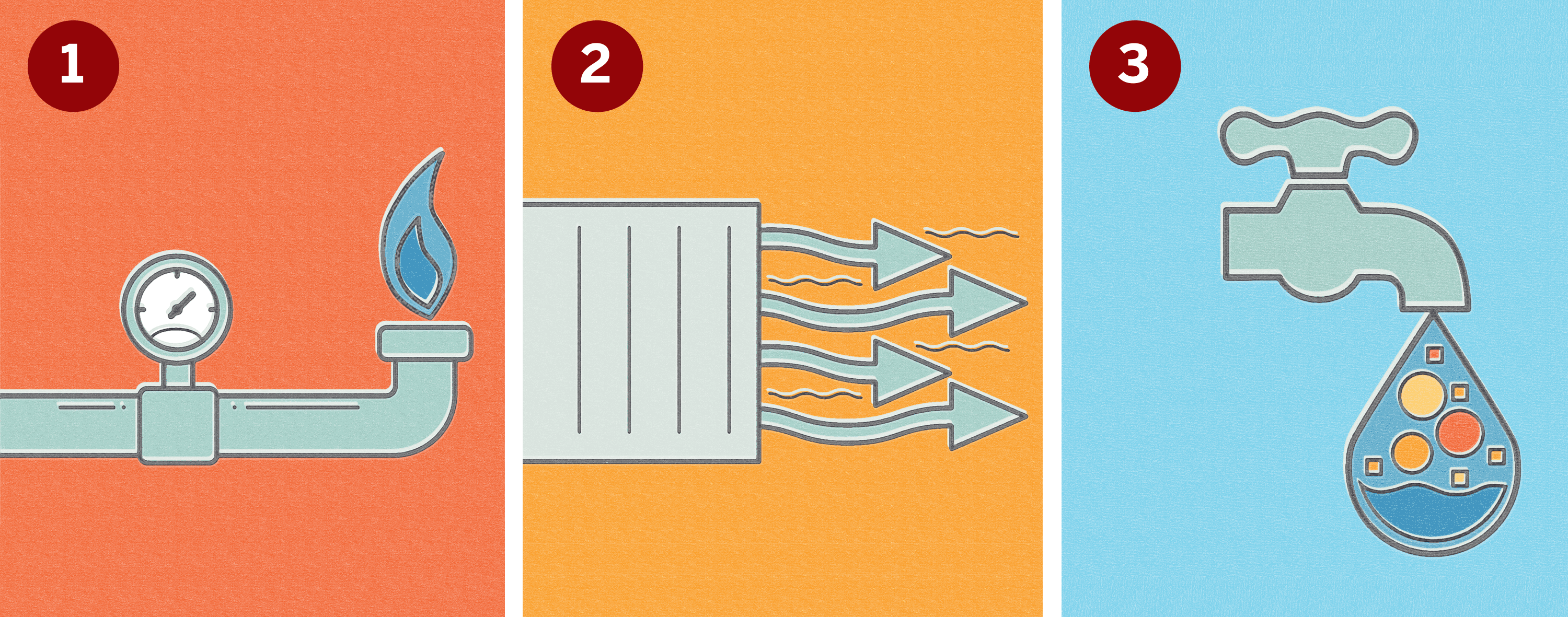
What you and your plumber need to assess before installation solar day:
Gas Line
For the burner in a tankless heater to perform properly, it has to be hooked up to a gas-supply line that delivers enough book at sufficient pressure level. In many cases that means the diameter of the supply pipe has to be increased to 3⁄4 inch. And if the pressure falls brusque, the gas company will accept to adapt the regulator on the meter.
FYI: Some tankless units, such equally those fabricated by Rheem, are able to work with a standard ½-inch gas line, provided it isn't longer than 24 feet.
Venting
Noncondensing tankless gas heaters employ stainless-steel vents that tin withstand high exhaust rut. Condensing units have a libation exhaust, and utilize less expensive PVC pipes. A concentric vent, which has an exhaust pipe inside a larger air-intake pipe, simplifies installation because only one pigsty needs to be cutting in the wall.
FYI: Typically, vent runs take been express to only 10 feet. But more than powerful fans, similar those in Rinnai's Sensei series, now allow vents to run up to 150 feet.
Water Hardness
Scale deposits that form in a heat exchanger (or on electric heating elements) wearisome down estrus transfer and constrict water period. Calibration won't be an issue if you already have whole-firm water-softening. Only if your water isn't being softened, and its hardness exceeds 120 milligrams per liter, and then it's worth investing in a treatment system.
FYI: A dedicated, betoken-of-use cartridge like the TAC-ler water conditioner (Stiebel Eltron) alters hardness without adding salt or other chemicals.
Outdoor Tankless Water Heater
:format(webp):no_upscale()/cdn.vox-cdn.com/uploads/chorus_asset/file/19524032/take_outside.jpg)
Consider the advantages of hanging a heater outdoors, if your climate and local codes permit.
- Saves infinite: That's one less appliance you have to make room for within.
- Unproblematic to install: The built-in exhaust vent eliminates having to cut a big hole (or two) through the side of the firm.
- Easy to service: A plumber can get to it at any time, whether you're abode or non. Merely keep in mind...
- Edifice regulations: You may need permission from your local edifice department to put it exterior.
- Common cold weather condition: Internal heaters continue components toasty downwards to −22-degrees F, only exposed water pipes must be insulated and wrapped in estrus record that turns on automatically in freezing temperatures. Frozen pipes are less of a business organization southward of the Bricklayer-Dixon Line.
Tankless Water Heater Venting
:format(webp):no_upscale()/cdn.vox-cdn.com/uploads/chorus_asset/file/19524116/vent_right.jpg)
Looking for assist with repairs around your home? A home warranty may help. Check out these in-depth guides from the This Quondam House Reviews Team:
- All-time home warranty companies
- American Home Shield reviews
- AFC Home Club reviews
- Select Home Warranty reviews
- Choice Home Warranty reviews

Source: https://www.thisoldhouse.com/plumbing/21019184/read-this-before-you-buy-a-tankless-water-heater
Posted by: brennanweared.blogspot.com
0 Response to "How Often Do I Have To Clean A Wholehouse Tankless Electric Water Heater"
Post a Comment